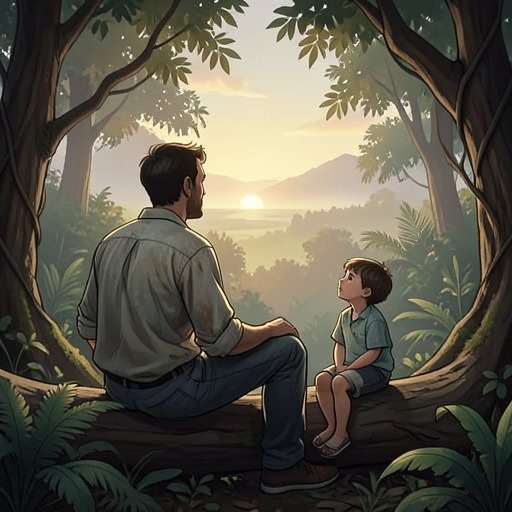
Kensuke and Michiya Ogawa
Kensuke's KingdomKensuke and Michiya Ogawa are father and son whose separation is shaped by war, mistaken assumptions, and the long persistence of memory. Kensuke believes Michiya and the rest of his family died in the atomic bombing of Nagasaki, while Michiya grows up believing his father was killed in the war. Their eventual connection is therefore indirect: Michiya discovers Kensuke’s survival through Michael’s account, and meets the boy who knew his father on the island.
Family Life Before the War
Kensuke recalls a life in Nagasaki with his wife, Kimi, and their young son, Michiya. Before the war, he had trained as a doctor in Tokyo and studied at Guy’s Hospital in London; back in Nagasaki, he worked as a physician, caring for mothers and babies. He describes himself as proud of his work and happy with his family. He often returned home from naval service to see Kimi and Michiya, who was growing quickly. The recollection establishes a domestic life interrupted, rather than replaced, by war: Kensuke’s later isolation is measured against the family he had known.
Kensuke’s account also gives Michiya a future imagined through absence. Years later, he says his son would have been nearly fifty if the bombing had not happened. This estimate makes the lost years concrete, while underscoring that Kensuke has no knowledge of the life Michiya actually lived after their separation.
War and the Assumed Loss of His Family
During the war, Kensuke served as a doctor aboard a Japanese warship. When American aircraft bombed the ship, he stayed with his patients; after further attacks, he found the people aboard dead and himself the sole survivor. The damaged ship continued moving, and he could not control its direction. Listening to the radio, he heard that an atomic bomb had fallen on Nagasaki. Because his mother and family were there, he concluded that Kimi and Michiya had been killed.
After Japan surrendered, Kensuke felt he had no reason to live, but the sea carried him and the ship to the island where he survived. He remained there for many years, keeping Kimi and Michiya in his thoughts even as he built a life apart from other people. His belief in their deaths helps explain why returning to Japan did not seem possible to him: he understood home as the place where his family had been lost, not as a place where they might still be found.
Memory, Isolation, and a New Family Bond
Kensuke’s memories of his son remain active during his life on the island. He tells Michael that Michiya is always in his mind, just as Kimi is, and imagines Michael’s mother carrying her missing child in her thoughts. The comparison links two forms of separation: Kensuke believes his family dead, while Michael’s mother may still be searching for her son. In speaking about both families, Kensuke recognizes that memory can preserve a relationship even when the people involved cannot be together.
His bond with Michael grows into a father-and-son relationship of its own. Kensuke tells him that he has come to think of Michael as a son, and that Michael feels like family. Yet Kensuke distinguishes their futures: Michael wants to return home, while Kensuke says he wants to remain on the island. The difference is not a rejection of Michiya. It reflects the life Kensuke has chosen after years of isolation and his conviction that his own family is gone. His affection for Michael makes their impending separation painful without erasing the older attachment he has never forgotten.
Kensuke also resists Michael’s suggestion that his family might have survived. He says he heard that Nagasaki was destroyed and remains certain that Kimi and Michiya are dead. The exchange briefly opens the possibility of return, but Kensuke closes it again, showing how firmly his understanding of the bombing has shaped his life. He continues to speak of Michiya with affection, while treating reunion as impossible.
The Reunion Through Michael’s Book
The novel’s closing letter overturns Kensuke’s certainty. Four years after the book’s first publication, Michael receives a letter from Michiya, who identifies himself as Kensuke’s son. Michiya explains that he had believed his father died in the war and that Kimi died only three years before he wrote. Kimi had remained convinced that Kensuke was dead. The letter reveals the painful symmetry: Kensuke mourned a family he thought the bomb had killed, while his surviving family mourned him.
Michiya says that he has no memories of his father, only photographs and Michael’s book. His discovery is therefore mediated by another person’s recollections: the island story gives him an account of a father he never had the chance to know. He writes that he would like to speak with Michael, who knew Kensuke, and hopes they might meet. A month after receiving the letter, Michael travels to Japan and meets Michiya. The narrator notes that Michiya laughs like his father, a small resemblance that makes their shared history present in the meeting.
Significance of the Relationship
Kensuke and Michiya’s relationship is defined by love that survives without contact, but also by the limits of what memory can establish. Kensuke remembers his son faithfully yet wrongly assumes he is dead; Michiya inherits the belief that his father died and grows up without personal memories of him. The book and Michael’s testimony become the bridge between those mistaken histories. Their eventual meeting does not restore the lost years between father and son, but it allows Michiya to learn that Kensuke survived and to approach his father’s life through someone who knew him. The closing encounter turns Kensuke’s private remembrance into a connection that can be carried forward by the next generation.